
What Is Métis Floral Beadwork? History, Meaning & Modern Art
Posted by Jason on Oct 25, 2026
What Is Métis Floral Beadwork? History, Meaning & Modern Art
Bright flowers. Curving stems. Colourful berries. Delicate leaves. Hundreds, sometimes thousands, of tiny beads carefully brought together to form something much larger.
Métis floral beadwork is one of the most recognizable artistic traditions associated with the Métis people.
For generations, Métis artists, particularly women, have used beadwork and embroidery to decorate clothing, moccasins, bags, mittens, jackets and other belongings. The colourful floral designs became so distinctive that Métis people came to be known by some of their First Nations relatives and neighbours as the “Flower Beadwork People.”
But Métis floral beadwork is much more than decoration.
It carries history, creativity, family knowledge and connection to place. And while the materials and artistic mediums used by Métis artists continue to evolve, the influence of those floral traditions can still be seen in contemporary Métis artwork today.
What Is Métis Floral Beadwork?
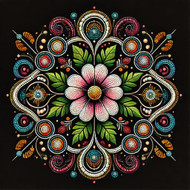
Métis floral beadwork is a distinctive style of beadwork known for its flowing botanical designs.
Flowers are often connected by curved stems and surrounded by leaves, buds, berries and other natural forms. Rather than appearing as isolated images, these elements frequently flow together across a piece, creating movement and balance.
The Canadian Museum of History describes Métis floral design as an artistic practice extending back more than 200 years. Métis women developed distinctive forms of needlework, quillwork, embroidery and beadwork by bringing together artistic practices from their Indigenous and non-Indigenous kin.
Over time, floral beadwork became especially associated with Métis artistic identity.
Historical pieces could be incredibly intricate. Tiny glass beads were sewn onto materials such as hide, wool, cloth and velvet, transforming everyday objects into works of art.
Why Were the Métis Called the “Flower Beadwork People”?
Métis beadwork became so well known for elaborate floral imagery that the Métis were sometimes referred to as the Flower Beadwork People.
The Gabriel Dumont Institute documents this long association between Métis identity and floral beadwork, while the Canadian Museum of History notes that the name reflected the large, colourful floral designs Métis artists created from the world around them.
The phrase is important because it tells us something about how recognizable Métis artistry became.
These were not simply decorative objects made privately within a household. Métis beadwork became admired and traded across communities and regions.
During the fur trade era, beautifully decorated moccasins and other pieces made by Métis and First Nations women were sought-after trade goods. Parks Canada notes that Métis women historically used beadwork on clothing, bags, gloves and moccasins, often creating colourful designs with glass seed beads against darker backgrounds.
Where Did Métis Floral Beadwork Come From?
Métis culture developed through relationships between Indigenous and European peoples, particularly across the historic fur trade and Red River worlds.
Métis art reflects that history.
Rather than coming from one single artistic tradition, Métis floral beadwork developed through generations of creativity, adaptation and exchange.
Métis women drew from Indigenous artistic practices including beadwork and quillwork while also encountering embroidery and needlework traditions connected to European communities and mission networks. Over time, Métis artists developed distinctive floral compositions of their own.
The Canadian Museum of History describes this process as Métis women blending the artistic practices of their Indigenous and non-Indigenous kin to create bright and elaborate designs.
That blending is part of what makes Métis art distinctive.
Métis culture has never simply been one tradition placed beside another. It developed into a culture, community and artistic language of its own.
Flowers, Leaves, Berries and the Natural World
Spend time looking at historic Métis beadwork and certain elements begin to appear again and again.
Flowers.
Leaves.
Curving stems.
Buds.
Berries.
Vines.
These designs often reflect an intimate relationship with the land and the plant life surrounding Métis communities.
The Canadian Museum of History specifically identifies curving stems, delicate leaves, berries, flower buds and flowers as recurring features of Métis floral design. It also notes that colours and designs could be associated with particular families.
That last point is especially important.
There is no single universal dictionary that says every flower, colour or leaf in Métis beadwork means exactly the same thing.
Art can carry family knowledge, regional influences, personal choices, community traditions and individual creativity.
That is why Métis beadwork should be understood as a living artistic practice rather than simply a collection of symbols.
Where Was Métis Beadwork Used?
Historically, beadwork could transform both practical and ceremonial belongings.
Métis floral designs appeared on items including:
moccasins, mittens, bags, jackets, hats, clothing, pouches and horse equipment.
These were objects people actually carried, wore and used.
A remarkable example held by the Manitoba Museum is an early Métis buffalo hunter's saddle decorated with detailed floral beadwork. The museum notes that the saddle is characteristic of those associated with Métis buffalo brigades and that its beadwork demonstrates highly skilled artistry.
Other surviving pieces provide an extraordinary record of the skill of earlier beadworkers.
The Manitoba Museum has documented a floral beaded panel that experts dated to the 1830s or earlier, demonstrating just how established sophisticated floral beadwork was by the early nineteenth century.
Every bead had to be selected.
Every colour had to work with the others.
Every curve had to be planned.
And every bead had to be attached by hand.
Beadwork as Knowledge
One of the most important things about Métis beadwork cannot be understood simply by looking at the finished object.
It is the process of learning how to make it.
Beadwork skills have often been shared through families and communities. The Canadian Museum of History notes that Métis beadwork and embroidery are frequently passed from one generation to another through hands-on and oral teaching. The conversations, stories and knowledge shared while creating can be as important as learning the technique itself.
That makes beadwork more than an artistic technique.
It can also become a place where knowledge is carried.
A grandmother teaching a grandchild.
An auntie showing someone how to form a flower.
An artist studying historic family designs.
A younger generation learning why certain patterns appeared on the belongings of their ancestors.
Art becomes another way history survives.
Métis Floral Beadwork Today
Métis beadwork is not an art form frozen in the nineteenth century.
It remains very much alive.
Contemporary Métis beadworkers continue to create traditional and innovative pieces, teach beadwork, study historic collections, recover family designs and develop new artistic expressions.
The Manitoba Museum's contemporary programming, for example, has featured Métis artists working in beadwork, clothing, embroidery and other traditional and contemporary forms. Some artists describe beadwork as part of reconnecting with family, community and Métis history.
The Gabriel Dumont Institute also continues to publish instructional and cultural resources specifically dedicated to Métis floral beadwork, including wâpikwaniy: A Beginner's Guide to Métis Floral Beadwork.
The tradition continues because artists continue to carry it forward.
But contemporary Métis art does not have to look exactly like historic beadwork to remain connected to Métis artistic history.
That is where another interesting story begins.
From Beads to Paint, Digital Art and Métis Dot Art
Today, Métis artists work in many mediums.
Some bead.
Some paint.
Some create textiles.
Some work digitally.
Some combine traditional techniques with entirely contemporary forms.
The visual influence of Métis floral traditions can extend beyond physical beadwork itself. Repetition, colour, flowers, natural forms, flowing lines and carefully placed dots can become part of paintings, illustrations and digital artwork.
It is important, however, to distinguish between these forms.
Métis Dot Art is not the same thing as traditional Métis beadwork.
Traditional beadwork is a specific artistic practice involving beads, materials, techniques and generations of knowledge.
Contemporary dot-based artwork is a different medium.
At Turtle Island Market, our Métis Dot Art is a contemporary digital art practice created by Métis artist Jason Hartung. The work draws inspiration from elements that have long appeared within Métis visual culture, including colour, repetition, floral imagery, wildlife, land and interconnected patterns, while using digital tools to create something new.
Rather than trying to reproduce beadwork digitally, the goal is to explore how Métis artistic influence can continue evolving through contemporary art.
That distinction matters.
Honouring tradition does not require pretending that modern art is traditional.
Métis art has always reflected creativity, adaptation and the world surrounding the artist.
Contemporary Métis artists are part of that continuing story.
Métis Art and the Land
One of the most interesting connections between historical beadwork and contemporary Métis art is the presence of the natural world.
Flowers and plants appear throughout historic floral designs.
In contemporary Métis artwork, that relationship can expand into entire landscapes.
Prairies.
Lakes.
Mountains.
Wildlife.
Shorelines.
Forests.
Water.
At Turtle Island Market, many Métis Dot Art pieces explore these relationships through Canadian landscapes and personal connections to place.
Works inspired by Manitoba canola fields, Lake Manitoba, Saskatchewan prairie landscapes, the Canadian Rockies, Kejimkujik, Thunder Bay and the Sleeping Giant use colour and dot-based patterning to interpret places that carry memory and meaning.
The medium has changed.
The relationship between art, land and story remains important.
Why Métis Floral Beadwork Still Matters
Historic Métis beadwork gives us something photographs and written histories cannot provide on their own.
It lets us see creativity.
We can see the decisions artists made about colour.
We can see enormous technical skill.
We can see relationships between generations.
We can see the influence of the land.
And we can see Métis people creating beauty while living through periods of enormous cultural, political and social change.
Many historical beadworkers never had their names recorded by museums or collectors.
Their artwork survived anyway.
Today, Métis artists and cultural institutions are helping reconnect those works with the people, communities and histories from which they came.
Contemporary artists are also building on that legacy by creating work that speaks to Métis identity today.
That is what makes Métis floral beadwork so much more than an artistic style.
It is part of a living cultural story.
Frequently Asked Questions About Métis Floral Beadwork
What is Métis floral beadwork?
Métis floral beadwork is a distinctive artistic tradition characterized by colourful flowers, leaves, buds, berries, stems and other natural forms created using beads. The style developed into one of the most recognizable forms of Métis visual art.
Why are Métis sometimes called the Flower Beadwork People?
Métis artists became particularly well known for elaborate floral beadwork. Some First Nations relatives and neighbouring peoples referred to the Métis as the Flower Beadwork People because of this distinctive artistic tradition.
How old is Métis floral beadwork?
Métis floral design represents more than 200 years of artistic practice. Museum collections contain sophisticated Métis floral beadwork dating to at least the early nineteenth century.
What items traditionally featured Métis beadwork?
Métis beadwork has appeared on moccasins, bags, mittens, hats, jackets, clothing and other belongings, as well as items associated with travel and horse culture.
Is Métis Dot Art the same as Métis beadwork?
No. Métis beadwork is a traditional artistic practice using physical beads and established techniques. Métis Dot Art is a contemporary art form that can draw inspiration from aspects of Métis visual culture while using a different medium and artistic process.
Exploring Métis Art Today
The story of Métis art did not end with the historic pieces preserved in museum collections.
Métis artists continue to create.
Traditions continue to be learned.
New materials continue to be explored.
And new generations continue to interpret relationships with culture, identity, family and land through art.
At Turtle Island Market, our contemporary Métis Dot Art collection continues that conversation through digital artwork inspired by Canadian landscapes, wildlife, flowers, water, memory and place.
Explore our Métis Dot Art collection to discover contemporary artwork by Métis artist Jason Hartung, or read What Is Métis Dot Art? Meaning, Culture, Colour & Storytelling to learn more about how this contemporary art form relates to the broader story of Métis creativity.
Traditions survive because they are remembered.
Cultures remain vibrant because they continue to create.